
THE RURAL ENERGY QUEST

The Rural Energy Quest — A Year of Rural Energy Choices is a digital educational game set in the rural valley of Riverstone, where a family must face a year of rising bills, inefficient buildings and difficult energy choices. Reducing consumption is not simply about switching off lights: players must understand where energy is lost, protect vulnerable people and plan realistic improvements.
In the first chapter, the player examines the farmhouse, interprets consumption patterns, improves insulation and selects the most effective solutions to get through the winter.
In the second chapter, the focus moves from the home to the farm. The player must turn the agricultural holding into a more efficient system by assessing building orientation, photovoltaic panels, hybrid wind-and-solar systems, geothermal heating for greenhouses and energy recovery from agricultural by-products. Each technology answers a specific problem and must be selected carefully.
The decisions are not only about innovation: players must avoid unsuitable or expensive solutions, integrate the available energy sources and maintain a balance between savings, reliability and climate-impact reduction.
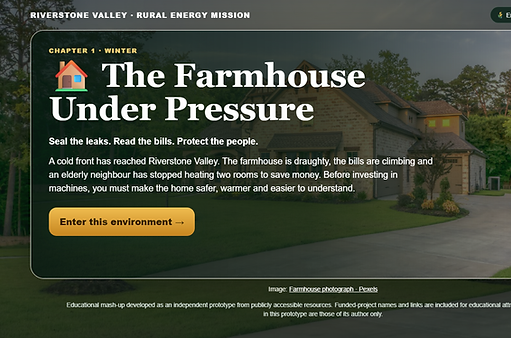

In the third chapter, the journey expands to the community. The player enters the village of Riverstone and tackles energy poverty, financial literacy, access to incentives and cooperation between residents, farmers and local authorities. The energy transition cannot be built by one household alone: it requires shared knowledge, collective decisions and accessible tools.
Through forty-eight choices distributed across four seasonal settings, the game turns complex ideas into practical challenges. The final result evaluates savings, climate impact and the ability to guide a rural community towards a more resilient future.
CLIMATE EMERGENCY ROOM

In the first chapter, the player enters the emergency coordination centre of Nova Riva, a European city facing a compound climate crisis. An extreme heatwave is affecting the most vulnerable districts, water reserves are falling rapidly and an intense storm front is moving towards the river basin. The player must understand that climate change does not generate one isolated problem, but a chain of interconnected impacts involving public health, infrastructure, agriculture and essential services.
Through the Heatwave Control Room, the player analyses an urban map, compares temperatures, tree canopy coverage and social vulnerability levels, and identifies the districts where cooling centres must be activated first. Decisions cannot be based only on the intensity of the heat: they must also consider elderly residents, vulnerable people, hospitals and neighbourhoods with limited green space. In this way, the game introduces the idea that climate adaptation must be targeted, inclusive and based on evidence.
In the second chapter, the crisis expands beyond the urban centre. The player enters the Agricultural Adaptation Lab and must protect vineyards, orchards and livestock farms threatened by drought and high temperatures. Each agricultural activity requires different measures: shading systems, efficient irrigation, water-reserve management and preventive planning. The most visible solutions are not necessarily the most effective ones: the player must select targeted interventions that respond to the actual vulnerabilities of the territory.
The journey then continues inside the Flood Observatory, where flood risk becomes increasingly urgent. The player reads hazard maps, activates monitoring systems, opens retention areas and protects strategic infrastructure. In the Service Grid Room, essential services must be restored in the correct order: backup power, water pumps, hospital continuity and public transport. This chapter shows that resilience does not depend on a single technology, but on the ability to coordinate different systems and understand their mutual dependencies.


In the third chapter, the journey expands to the wider community. The player enters the Public Communication Studio and must transform technical data and warning signals into a clear, accessible and verifiable public message. Ineffective communication can increase risk even when the underlying information is correct. The player must therefore choose the right wording, identify the affected areas, explain the actions residents should take and direct citizens towards verified channels. Visual storytelling, inspired by climate comics and educational narratives, becomes a practical tool for preparedness.
In the final Strategy Chamber, all previous decisions are combined into one adaptation plan. The player works with a limited budget and must select measures covering urban heat, agriculture, flood risk, essential services and public communication. Through six interactive rooms and a sequence of strategic choices, the game transforms complex climate concepts into practical challenges. The final result evaluates the player’s ability to guide a city towards greater resilience, avoiding symbolic actions and prioritising integrated, concrete and community-oriented solutions.
MEDITERRANEAN FOODSCAPE
CLICK ON THE PICTURES TO PLAY THE GAME

In the first chapter, the player takes on the role of a young chef-planner called upon to intervene in an increasingly fragile Mediterranean food system. The seas are under increasing pressure, many foods travel thousands of kilometers before reaching the table, and some local traditions are at risk of disappearing from everyday menus. The player must understand that every food choice has consequences that go beyond the individual meal and involve the environment, local economy, public health, and the cultural identity of the regions.
Through the Three Horizons method, the game invites us to compare the current food system with the one we hope for in 2040. The menu represents the bridge between these two horizons: a seemingly simple tool, yet capable of guiding production chains, consumption habits, and relationships with the local area. Before starting service, the player must therefore choose their strategic vision: building a more resilient local food network, promoting a revival of gastronomic traditions, or making sustainable food accessible to all segments of the population.
In the second chapter, the player enters the kitchen and chooses one of six available operational contexts: a trattoria on the Adriatic coast, a school cafeteria in the Apulian hinterland, a European institutional dinner, a farmhouse surrounded by olive groves, a kitchen for patients and the elderly, or a food stand at a village festival. Each scenario has a specific budget, a different audience, and concrete constraints. A menu suitable for tourists in a coastal town cannot be designed with the same criteria used for a school, a hospital, or a folk festival.
The player must compose a complete menu by selecting an appetizer, first course, second course, side dish, dessert, and drink. Each dish is evaluated across eight dimensions: seasonality, short supply chain, marine conservation, waste reduction, nutritional value, affordability, gastronomic heritage, and ability to convey the territory. Decisions cannot be based solely on taste or price: it is necessary to balance environmental sustainability, food quality, economic feasibility, and the valorization of local identities.


In the third chapter, service begins and the menu is put to the test by unexpected situations. A heat wave can compromise the supply of certain ingredients, a busload of visitors can arrive unannounced, a vegan delegation can sit at the tables of the institutional dinner, and a health inspector can check the amount of waste produced by the kitchen. The player thus discovers that a sustainable menu must not only work on paper but must be able to withstand the pressures of the real world.
At the end of the service, the game returns an overall score and identifies the strengths and weaknesses of the proposed menu.
HEMP APP

HEMP Business Lab — From Product to Market is a digital educational game focused on the entrepreneurial stage of the hemp value chain. Having a strong product is not enough: building a sustainable business requires realistic market positioning, solid stakeholder relationships, compliance with applicable rules and credible communication.
Across five missions, players must select the most suitable market, build a value-chain network, pass a compliance check, define the brand identity and present a balanced business case. Resources are limited, and every choice has practical consequences.
HEMP Factory — From Plant to Product is a digital educational game focused on the circular processing of industrial hemp. The harvest is complete, but the biorefinery has come to a standstill: fibres, hemp shives, seeds and residues must be directed towards the most suitable processing lines before the raw materials deteriorate.
Through five interactive missions, players must reactivate the plant, sort the different parts of the crop correctly, recover by-products and identify the most appropriate target markets. The objective is to minimise waste and make the best possible use of every available resource.


HEMP Business Lab — From Product to Market is a digital educational game focused on the entrepreneurial stage of the hemp value chain. Having a strong product is not enough: building a sustainable business requires realistic market positioning, solid stakeholder relationships, compliance with applicable rules and credible communication.
Across five missions, players must select the most suitable market, build a value-chain network, pass a compliance check, define the brand identity and present a balanced business case. Resources are limited, and every choice has practical consequences.
The True Cost of Fashion
CLICK ON THE PICTURES TO PLAY THE GAME
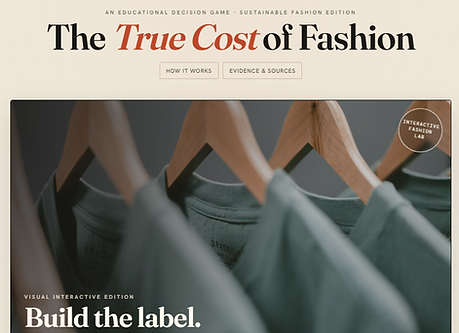
The True Cost of Fashion is a digital educational game focused on the main environmental, social and economic choices behind the fashion supply chain. The player takes the role of an emerging fashion brand and designs different collections, making operational decisions on materials, manufacturing, dyeing, finishing, logistics and sales models.
From conventional cotton to recycled fibres, from low-cost production to transparent supply chains, the game introduces the hidden impacts behind every garment: water consumption, emissions, chemicals, working conditions, traceability and end-of-life management. Each decision changes the Planet, People, Circularity, Traceability and Profit indicators, showing that the retail price of a product never reflects its full real cost.


Through a quick mode and a complete mode, the game guides students, young consumers and training providers through an interactive experience on sustainable fashion. The aim is not to find a perfect solution, but to understand the trade-offs of the green transition and build a more responsible, competitive and conscious business model.
GREEN GRAND PRIX
CLICK ON THE PICTURES TO PLAY THE GAME

Green Grand Prix is a browser-based educational game in which students step into the role of a Grand Prix organising committee with a single goal: to build the most sustainable race weekend possible. Behind the spectacle on track lies a genuine management challenge: every decision — how fans arrive, how the paddock is powered, what people eat, how the event is communicated — moves six interconnected indicators, from CO₂ emissions and cost to public satisfaction, reputation, inclusion and experience quality. The budget is never enough to make the best choice everywhere, so the game forces players to think in terms of priorities, exactly as in real life.
The depth comes from context. Players choose among eight real circuits — from Monza and Imola in the Motor Valley to Silverstone, Spa, Barcelona, Zandvoort, Suzuka and Las Vegas — and each one rewrites the rules: rail access at Monza, the protected dunes and coastal wind at Zandvoort, the desert sun and long-haul flights at Las Vegas. On top of this sit three difficulty levels, seventeen decision departments grouped into five phases, an anti-greenwashing mechanic that punishes anyone who promises more than they deliver, and carbon measurement (scope 1-2-3) as a requirement for earning the three environmental stars. There is a single-race mode complete with a certificate, and a Season mode — a full points-based world championship with a personal best and standings you can export as an image.


Green Grand Prix is inspired by the results of the Erasmus+ SEED project — Sustainable Events for Education and Development, in which CULTUM was an associated partner — carrying its principles for designing sustainable events into the world of motorsport. Bilingual (Italian and English) and aligned with the European sustainability competence framework (GreenComp) and UNESCO's Greening Education Partnership, it is designed for technical schools and academic upper-secondary schools close to Ferrari, the Formula 1 teams and the British University Technical Colleges, engaging a wide range of profiles — mechanics, electronics, IT, management, communication, tourism and the environment. Produced by CULTUM, it is an independent educational resource that turns a universal passion, racing, into a hands-on training ground for sustainable thinking.